

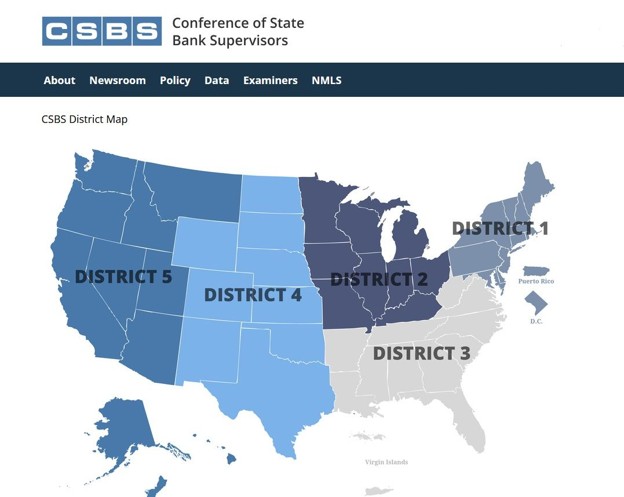
On October 6, Federal Reserve (the Fed) Vice Chair for Supervision Michelle W. Bowman delivered remarks at the 2026 Community Banking Research Conference in St. Louis, sponsored jointly by the Federal Reserve System, the Conference of State Bank Supervisors (CSBS), and the Federal Deposit Insurance Corporation (FDIC), announcing a significant structural change to Federal Reserve bank supervision. The Fed’s supervisory function will be reorganized into five regions modeled on CSBS’s own regional structure and aligned to state boundaries rather than the traditional twelve Federal Reserve District lines.
A New Regional Structure, Built on Accountability
Bowman described a long-standing mismatch between decisionmaking authority (held by the Vice Chair for Supervision) and the actual conduct of supervision (carried out by the twelve individual Reserve Banks), compounded by what she called a “complex web of dozens of committees” that created delay, diffused accountability, and discouraged examiners from acting decisively on identified risks.
The new five-region model is intended to fix that mismatch. Each region will have a single accountable regional leader overseeing all supervisory activity, while front-line examiners remain embedded in their existing Reserve Bank locations, continuing to supervise the institutions they know. Because the new regions follow state lines rather than Reserve Bank District boundaries, Bowman argued the structure will also improve coordination with state and federal regulatory counterparts, since state member banks are supervised jointly with the state chartering authority. CSBS’s own district map, which groups states into five supervisory districts, served as a model for this realignment.
Rethinking Asset Thresholds
Bowman also previewed upcoming changes to how the Fed calibrates regulation by bank size. She criticized “static” fixed-dollar thresholds, such as Regulation O’s limits on loans to bank insiders, which haven’t been comprehensively updated since 1979, as creating disproportionate burden without a corresponding safety-and-soundness benefit. Later this year, the Fed plans to propose indexing these fixed-dollar thresholds to inflation and economic growth, with built-in adjustments every five years going forward.
More notably, Bowman flagged that the Board will also reconsider the $10 billion asset threshold that has defined “community bank” status for the past 15 years, suggesting that both raising the ceiling and re-examining which institutions fall into which supervisory tier could better align oversight with a bank’s actual risk profile and business model, rather than size alone.
Other Priorities on the Table
Bowman identified three remaining priorities for community banks specifically:
- M&A competitive analysis – She criticized the Fed’s current merger-review framework as outdated and overly punitive toward rural and small-market banks, arguing it fails to account for competition from credit unions, nonbank lenders, farm credit institutions, and branchless banks.
- De novo bank formation – Building on the Federal Financial Institutions Examination Council (FFIEC) June statement supporting new bank charters, Bowman called for clearer approval standards, firmer processing timelines, and greater use of conditional approvals.
- Call Report streamlining – Following the FFIEC’s December 2025 request for information, the agencies continue to look for ways to reduce the reporting burden on filing institutions.
CAMELS Reform
Finally, Bowman addressed progress on revising the CAMELS rating system through the FFIEC. Under the proposed revisions, the “Management” (M) component would no longer single-handedly drive a bank’s overall composite rating, a shift intended to make the rating framework more reflective of actual financial condition and risk rather than being overly weighted toward management/process findings.
Why It Matters
Taken together, Bowman’s remarks suggest the Fed is moving on multiple fronts simultaneously: reorganizing its own internal supervisory apparatus, recalibrating the size-based thresholds that determine regulatory burden, and continuing to push CAMELS and tailoring reforms that have been in motion since the Fed’s Statement of Supervisory Operating Principles was introduced roughly a year ago. For community and regional banks, the regional restructuring and threshold changes could materially affect how their institution is categorized and examined going forward.